
Synthetic Peer Aggression:
The Rise of “AI Bullying” in Schools
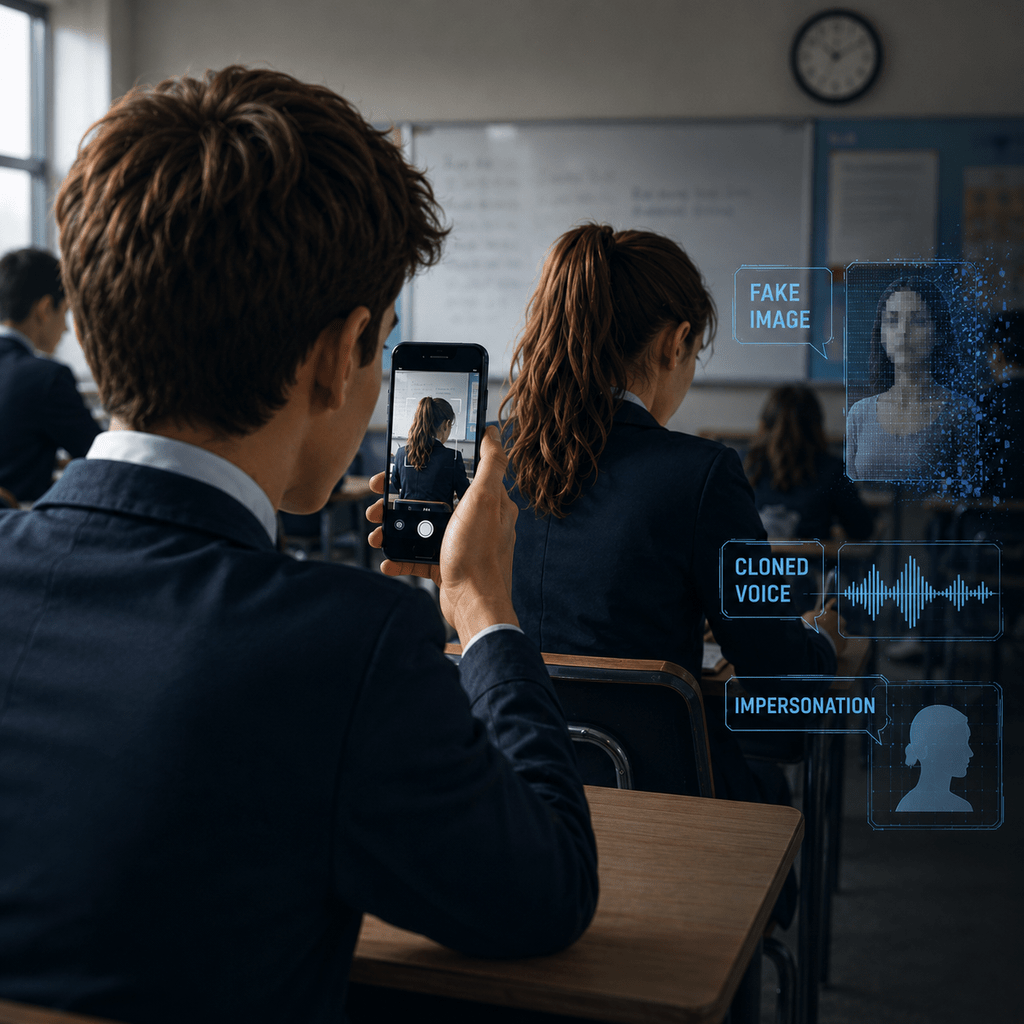
Last month we looked at the laws trying to catch up with kids’ digital lives. This month we’re looking at what’s slipping through the gaps: generative AI tools that let one child weaponise another’s photo, voice or identity in seconds.
Researchers have started calling it synthetic peer aggression — bullying built with generative AI, rather than just amplified by social media. It covers AI-faked nude or explicit images of a classmate, cloned voices used to humiliate or extort, and impersonation of both students and staff. Unlike a lot of the digital risks we cover on this blog, this isn’t an emerging concern. School leaders are already dealing with it, right now, in real hallways.
Here’s what the numbers say, what it actually looks like in real cases, what the law does and doesn’t cover, why so many affected kids stay quiet, and what you can do about it as a parent.
The numbers behind “AI bullying”
A nationally representative RAND survey of 957 US school principals — fielded in October 2024, covering the 2023–24 and 2024–25 school years — found that 13% had dealt with a bullying incident involving AI-generated deepfakes. Break it down by school level and the picture gets worse fast: 8% in elementary schools, 20% in middle schools, and 22% in high schools. As RAND puts it, that means essentially one in five secondary schools has already had to handle bullying or victimisation involving AI-generated images or video.
This is the headline stat behind our whole September theme, because it settles an obvious question upfront: is this actually happening at scale, or is it a handful of extreme cases making headlines? RAND’s answer, from a nationally representative sample, is that it’s already routine.
Nudify apps and why any photo is now raw material
A big share of synthetic peer aggression runs through so-called “nudify” apps and sites — tools that take an ordinary, fully clothed photo and generate a fake explicit image from it. They’re often free, and using one takes no technical skill at all. That combination — zero cost, zero expertise required — is what has made them so hard to contain: in September 2023 alone, an estimated 24 million people visited undressing websites, according to the social-network analysis firm Graphika.
The practical implication for parents is blunt: any photo of your child that exists online — a school photo, a sports team pic, a selfie on a public profile — is potential raw material. You don’t need to have done anything risky online for this to reach your child; you just need to have a face that’s been photographed and posted.
Separately, the FBI’s National Center for Missing & Exploited Children (NCMEC) reported that CyberTipline reports flagged as involving generative AI technology rose by roughly 1,325% in 2024. Worth flagging honestly: investigative reporting has since shown a large share of that specific spike came from one company’s bulk use of the “generative AI” checkbox while hash-matching known abuse material during AI-training-data reviews, rather than from a like-for-like increase in newly created synthetic images — so treat that exact percentage with some caution. What isn’t in dispute is the underlying direction: AI-facilitated child exploitation reports are climbing, and the tooling to produce this material has never been more accessible.
When it isn’t hypothetical
It’s easy for statistics to feel abstract, so here are two real, named incidents from the past school year.
In fall 2025, AI-generated nude images of students swept through a middle school in Louisiana. Two boys were ultimately charged — but not before one of the victims was expelled, after a fight with a boy she accused of creating the images of her and her friends.
At Westfield High School in New Jersey, at least 30 female students had their faces morphed onto explicit images, generated by a classmate using an AI app.
“Kids are sending out a picture to somebody, and that picture gets converted into something it wasn’t. Now they’re saying, ‘Hey, pay this or I’m going to tell all your friends and family,'” says Jennifer Duer, Executive Vice President of Product at Lightspeed Systems, describing how these fabricated images are increasingly used to fuel sextortion.
It moves fast, and it moves through the same group chats and Discord servers your kids are already in.
Sometimes the “bully” isn’t even a classmate
We covered AI companion apps back in July, and there’s a darker overlap with this month’s theme worth naming directly: students are using AI tools to impersonate not just classmates, but staff. “Students are taking pictures of staff members and using AI to make it look like staff members did something inappropriate,” Duer told EdTech Magazine, describing the investigations and suspensions that follow. Whether the harassment comes from a classmate wielding an AI editing tool, or from a companion app amplifying a child’s worst thoughts back at them, the common thread is the same: a technology built to feel human, deployed without the target’s consent and often without the user’s full understanding of the harm it causes.
Does the law actually protect your child from this?
In South Africa, yes — partly. The Cybercrimes Act 19 of 2020 criminalises the electronic disclosure of intimate images without consent, and legal commentary confirms this extends to simulated content: a deepfake doesn’t escape liability just because it was artificially generated rather than photographed. The Protection of Personal Information Act (POPIA) adds a civil route, letting victims claim damages where the harm is reputational or emotional, and the Protection from Harassment Act allows victims to obtain protection orders to stop ongoing online harassment.
Where the gap shows up isn’t the law on paper — it’s enforcement in practice: capacity constraints at the police and prosecution level, litigation delays, anonymous perpetrators, and platforms based overseas responding slowly (if at all) to South African court orders. And there’s still no law written specifically for AI-generated content as a category — we’re relying on statutes that were never built with this technology in mind.
Elsewhere, legislators are moving faster on the specific problem of nudify apps. Minnesota’s ban on AI “nudification” tools took effect on 1 August 2026, after a judge refused an emergency request from Elon Musk’s xAI to block it — a legal challenge that is still working its way through court. It’s an early signal of where regulation is heading, even if South Africa isn’t there yet.
Why your child might not tell you
Even when a deepfake is obviously fake to an adult eye, the emotional harm to the child it depicts is real. Australia’s eSafety Commissioner, which runs a dedicated deepfake takedown scheme, reports that deepfake image-based abuse is now happening at least once a week in Australian schools, with reports doubling over the past 18 months — and yet many affected students never come forward. eSafety’s own casework points to six specific reasons kids stay silent: they don’t know anyone can actually help; they’re afraid of shame if it circulates further in group chats or school gossip; they worry adults won’t believe the image is fake; they expect to be blamed or have their device taken away; they’ve concluded nothing will improve if they speak up; and they’re afraid that speaking up will trigger an overreaction — police or media involvement — before they’re ready for that.
That last set of fears points squarely at the one thing every parent actually controls: how we react in the moment our child does come to us. As we’ve said before on this blog: “You will never be in trouble for coming to me. No matter what happened, no matter what you sent — I will always be on your side.” Said before anything ever goes wrong, that single sentence is one of the most protective things you can offer.
It’s also worth knowing that when a deepfake does get reported to the right place, takedown works: eSafety reports a 98% success rate getting deepfake images removed from platforms once its office is involved.
Is your child’s school actually ready for this?
The honest answer, for most schools, is not yet. Industry research from Linewize found that 62% of students say they’re worried about generative AI being weaponised for bullying, while only 36% of teachers believe their school offers adequate support to victims of deepfake abuse — and just 7% of schools or districts have gone as far as banning generative AI outright (a blunt instrument that arguably misses the point, since the harm here is about non-consensual, harmful use, not AI use in general).
It’s worth asking your child’s school directly: does our policy name AI-generated content specifically, rather than relying on an old cyberbullying policy that assumes a real photo? Who handles a report if it comes in, and how fast? Those two questions alone will tell you a lot about how ready a school actually is.
Six things you can do about AI bullying, starting today
- Talk to your kids about nudify apps and deepfakes before they encounter them, not after. Waiting for “the right moment” usually means waiting too long.
- Say it out loud, explicitly: coming to you is never the wrong choice, no matter what happened or what was sent.
- Ask your child’s school what its AI misuse policy actually says, and who owns a response when a report comes in.
- Know your legal footing. South Africa’s Cybercrimes Act covers deepfake images — keep evidence, don’t delete anything, and report to the SAPS Cybercrime Unit if it happens to your family.
- Use tools built to catch this early, so you’re not relying on catching it yourself. Bark uses AI to scan messages and 30+ apps for cyberbullying, grooming and other concerning content.
- Revisit our Six Pillars framework as a starting checklist for the conversation at home.
Not sure which of our tools fits your family? Take our quick quiz
The month in one place
Everything above is also running across our social channels throughout September — the numbers, the real cases, the law, AI companions, why kids stay silent, the school gap, and this six-point action list, each broken into its own post. If you follow us on Facebook or Instagram, you’ll see the full series; this post is the long-form version for anyone who wants the whole picture, and the sources, in one place.
The technology moved fast. The conversation at home is what closes the gap — and it starts with one sentence, said before anything goes wrong: you will always be on their side.
Further reading on this blog: The Hidden Pandemic: What Every Parent Needs to Know About Financial Sextortion and AI Exploitation · The AI Companion Crisis · The 2026 Regulatory Wave
Sources:
- RAND Corporation, Artificially Intelligent Bullies: Dealing with Deepfakes in K–12 Schools (2025)
- Fortune, Nudify apps and the rise of AI-generated deepfakes (Dec 2023), citing Graphika
- NCMEC, NCMEC Releases New Data: 2024 in Numbers
- TechDirt, Six Months Of “AI CSAM Crisis” Headlines Were Based On Misleading Data (Feb 2026)
- PBS NewsHour / AP, The rise of deepfake cyberbullying poses a growing problem for schools (Dec 2025)
- EdTech Magazine, Deepfakes in Education: Cyberbullying in the Age of AI (Jun 2026)
- Cliffe Dekker Hofmeyr, Social media and AI: Legal risks and South Africa’s response (Mar 2026)
- FOX 9 / TechCrunch / MPR News, on Minnesota’s “nudify” app ban taking effect 1 August 2026 and the xAI legal challenge
- eSafety Commissioner (Australia), eSafety urges schools to report deepfakes as numbers double and Deepfake damage in schools
- Linewize, The Use of AI Deepfakes in Cyberbullying